PPC Overspending Audit Checklist
In recent months, there has been a noticeable rise in requests to audit advertising accounts for overspending. To help advertisers identify potential waste and inefficiencies, here’s a detailed checklist of the most important questions to ask. Although this guide is Google Ads–centric, the insights can be applied across most digital advertising platforms.
Are Conversion Actions Accurate?
One of the leading causes of wasted ad spend is inaccurate conversion tracking. When your data is flawed, automated bidding strategies often misallocate budget toward low-value actions. Ensuring your conversions are set up correctly is foundational for campaign optimization.
Common Conversion Tracking Issues
- Double Counting: This occurs when a single user action is recorded more than once. For example, a purchase event could be triggered both by a thank-you page view and a separate purchase script, inflating your results.
- Missing or Default Conversion Values: When no values are assigned, Google Ads will default to a $1 value. This may be fine for early-stage campaigns, but over time you need to attribute actual monetary value or use micro-conversions that reflect meaningful steps toward your ultimate goal.
- Improper Primary Conversion Settings: Only primary conversions impact bidding algorithms. If too many are set as primary, or if key actions are missing, you could be overvaluing the wrong steps in your funnel.
To review and adjust these, head over to the “Goals” section within your Google Ads account. This is where you manage your conversion actions, assign values, and mark actions as primary or secondary.
Is Cost Per Click Higher Than Average?
Expensive clicks don’t always indicate better results. In fact, high CPCs can be a symptom of inefficient targeting or increased competition. Understanding where and why your CPCs are inflated is crucial to getting better value from your campaigns.
What Can Drive Up CPCs
- Unintended Auction Participation: Broad match keywords or audience targeting can place your ads into auctions unrelated to your core offering.
- Geographic Spread: Some regions are simply more competitive than others. A campaign targeting high-cost areas may suffer compared to one targeting regions with less bidding pressure.
- New Market Entrants: A surge in CPCs may also result from new advertisers entering your niche and aggressively outbidding others.
The “Insights” tab within Google Ads offers reports such as “When and Where Ads Served,” which help pinpoint which placements and times are draining your budget.
Target Based on Profitability, Not Preference
Just because a location or keyword is emotionally appealing doesn’t mean it’s profitable. For instance, one search term might cost twice as much as another, despite offering similar intent. In such cases, prioritize based on conversion rates and return on ad spend (ROAS), not assumptions.
Are Exclusions Present?
Failure to use exclusions is a common reason for overspending. Negative keywords, placement exclusions, and audience exclusions help eliminate unqualified traffic, ensuring your budget focuses only on valuable prospects.
Types of Exclusions
- Negative Keywords: These prevent your ads from showing on irrelevant queries that sound similar to your main keywords but don’t convert.
- Placement Exclusions: Especially important in display and YouTube campaigns, these help you avoid websites or channels with poor engagement or brand mismatch.
- Audience Exclusions: Use first-party data or behavioral signals to exclude users who already converted or are unlikely to convert.
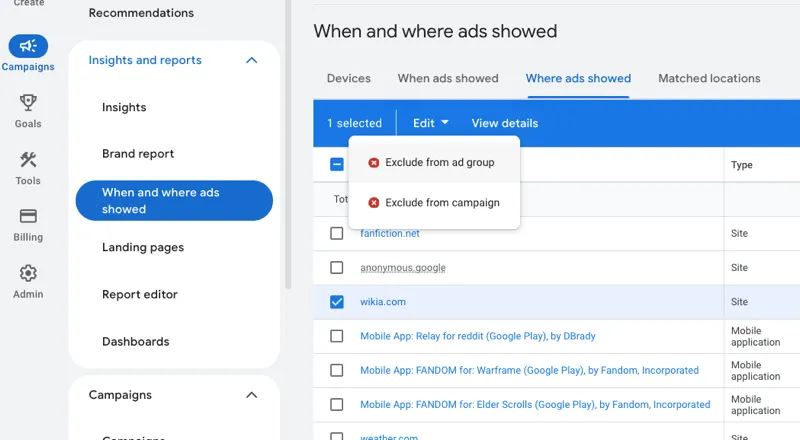
Placement exclusions in Google Ads
Most exclusions can be set at the account level, but it’s still essential to review them at the campaign and ad group levels. For Performance Max campaigns, audience exclusions must be implemented at the campaign level and can be configured to focus only on acquiring new customers.
Can the Budget Support the Targets You’ve Set?
Another frequent issue is spreading a limited budget too thin across multiple goals. If you’re targeting a wide array of keywords, locations, audiences, or products, each with differing ROAS potential and auction prices, you risk misallocating your spend.
Evaluate Campaign Focus and Margin Differences
Let’s say your company sells three services priced at $500, $2,500, and $5,000 respectively. If all three services are under the same campaign, the algorithm might favor the cheaper product due to its higher volume, even if the margin is lower. This dilutes overall ROI.
Geographic Targeting and Fulfillment Realities
If your fulfillment is stronger in certain regions, concentrate your ad spend there. Similarly, distinguish between mature markets (with established demand) and emerging ones. Trying to win both simultaneously may lead to underperformance in both areas.
Shared Budgets and Bidding Conflicts
Since ad groups share a campaign’s budget, they will compete with each other. The ones driving the most conversions—often the cheaper, lower-value ones—will dominate. As a result, high-value conversions might be underrepresented due to limited exposure.
Final Takeaways
Overspending in PPC can be stressful, but a consistent audit process can uncover the inefficiencies that drain your budget. Build a weekly habit of checking auction prices, search terms, and placements, and commit to a quarterly deep-dive to reassess campaign goals, targeting, and exclusions.
By identifying weak spots and optimizing based on data, you’ll ensure your ad budget is always aligned with performance and business value.