Location Targeting
One of the most overlooked yet critical aspects of running international PPC campaigns is location targeting. Google Ads, by default, includes users who have shown interest in your targeted location, which can lead to impressions and clicks from people who aren’t physically there.
To ensure your ads are only reaching users actually within your intended market, adjust your location settings to “Presence: People in or regularly in your targeted locations.” This prevents your budget from being spent on irrelevant clicks from users outside the target region.
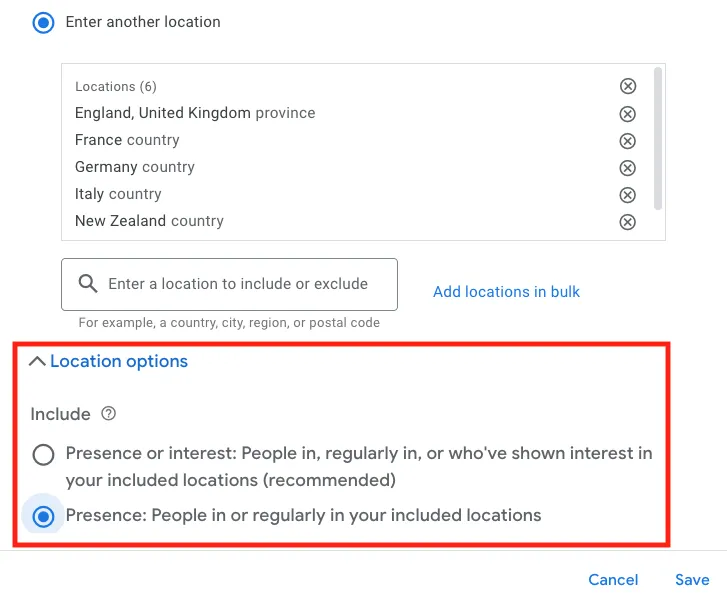
Failing to tighten this setting could result in misleading metrics and wasted spend, especially when running multiple campaigns across borders.
Ad Scheduling
Time zones are a silent campaign killer when you go international. An ad scheduled for peak hours in Los Angeles could be running during the middle of the night in Berlin. Even if your current ad schedule is optimized for your local audience, it won’t necessarily translate globally.
To fix this, ensure your ad schedule aligns with the local time of the country you are targeting. This ensures your ads are seen when your audience is most likely to engage. A best practice is to create separate ad accounts for each market, so you can set the time zone appropriately at the account level and avoid confusing time conversions.
Currency and Conversion Tracking
Currency mismatches can wreak havoc on your campaign reporting. Suppose you’re spending in euros but tracking revenue in dollars—you could mistakenly assume a higher return on ad spend than you’re actually achieving.
Always confirm that your billing currency matches your performance reporting currency. Likewise, ensure your conversion values are set in the local currency to avoid misinterpreting performance data. Again, using separate ad accounts for each country can help you avoid these kinds of critical errors.
Language Settings
Language targeting in Google Ads does not mean your ads are automatically translated. It simply targets users based on the language of their browser or Google interface. That means if you’re targeting Brazil but only using English ads and keywords, you’re missing the majority of the market.
To effectively reach users, create separate campaigns for each language spoken in your target region. Use native keywords and professionally translated, localized ad copy that matches how users actually search and speak.
Keyword Match Types
User search behavior can differ widely from country to country. Broad match keywords that perform well in Canada may trigger irrelevant searches in Italy. In some cases, even direct translations of keywords may have unintended or misleading meanings.
To mitigate risk, research local search trends and start with more controlled match types like phrase and exact match. Analyze your search term reports often to catch surprises early, and implement a negative keyword strategy from day one to keep your campaign focused.
Bidding Strategies
Automated bidding strategies can behave unpredictably across markets. A Target CPA of $60 might work in Australia but could be too high or low in other regions where CPCs and competition levels vary.
Start with manual bidding or “Maximize Clicks” in new markets to gather baseline performance data. Once you understand the local dynamics, you can begin testing Smart Bidding strategies. Be patient—machine learning needs time to adjust to new behavioral patterns in unfamiliar markets.
Product Feed Optimization
For Google Shopping campaigns, simply using the same product feed across countries can limit your results. Local shoppers often use different terminology, pricing expectations, and purchase triggers.
Localize your product titles and descriptions using the correct terms for each region—think “jumper” vs. “sweater” or “trainers” vs. “sneakers.” Also, verify your feed includes accurate pricing in the local currency and complies with that country’s requirements for tax and shipping display.
Visual content should be reviewed too. Some imagery may be acceptable in one country but culturally inappropriate or ineffective in another.
Regulatory and Compliance Settings
Each country has its own digital advertising rules. The European Union’s data protection laws, for instance, require explicit user consent for remarketing efforts involving cookies. Countries like Japan, India, and Canada also have specific advertising standards, especially in regulated industries.
Before launching, familiarize yourself with legal obligations in your target markets. Your ad creatives, landing pages, and data collection methods must meet local compliance standards. Consult official Google policy pages for guidance, but also consider legal counsel for industries with higher compliance risk.
Payment Methods
Google Ads offers different payment methods depending on the country. Some regions don’t support common U.S. payment types or have unique billing requirements. That could delay your campaign or even cause it to stop if billing fails.
To avoid interruptions, verify the available payment methods for your target country ahead of time. If you’re running campaigns across multiple countries, having separate ad accounts with localized payment settings can reduce billing issues significantly.
Audience Targeting
Audiences built from your U.S. campaigns won’t necessarily work abroad. Behavioral data, demographics, and consumer psychology all vary between countries. Even lookalike audiences may fail to perform if based on irrelevant data.
Build fresh audience segments for each market using local behavioral signals. Google Ads’ in-market audiences and custom segments can be powerful when tailored to regional intent. Test audiences separately and optimize based on real performance data—not assumptions.
Ad Copy and Ad Assets
Translating your ads isn’t enough—you need to adapt them. Humor, urgency, tone, and even the structure of messaging differ greatly by culture. An ad emphasizing discounts and limited-time offers may resonate in one country but feel overly aggressive in another.
Work with native speakers or cultural consultants to refine your copy. Adjust structured snippets, callouts, and extensions to reflect local values and norms. Your ads should feel familiar, not foreign, to the users in each region.
Competitive Analysis
Benchmarking performance using your home country as a reference point is risky. Metrics like CPCs, CTRs, and conversion rates vary widely across regions. A top-performing campaign in the U.S. could underperform in Singapore due to different competitive landscapes.
Use Google Ads Auction Insights and third-party tools to understand your competition in each market. This helps you set more realistic performance goals and make smarter budgeting decisions from the start.
Landing Pages
Your landing page experience must match the expectations of local users. Sending users in Mexico to a U.K. English page with prices in pounds will instantly reduce your credibility and kill your conversion rates.
Ensure that landing pages are fully localized in terms of language, cultural references, legal disclaimers, and currency. Pay attention to seemingly minor details—terms like “add to basket” vs. “add to cart” can make a surprising difference in conversion performance.
Fine-Tune Your Strategy Before Expanding Globally
International PPC campaigns are filled with potential, but they demand more than just copying and pasting your existing campaigns into new locations. Each country introduces unique challenges in language, user behavior, legal requirements, and ad platform settings.
By taking the time to adjust each key setting—from location and language to bidding strategies and landing page content—you reduce wasted spend and increase the likelihood of long-term success. With thoughtful planning and localized execution, your global PPC campaigns can drive real growth across markets.