The Learning Phase Guide: Optimizing CPA and Boosting Conversions
Unveil the strategies for maximizing your learning phase to achieve reduced CPA and enhanced conversion rates.
Overview
The Learning Phase: An Introduction
In the Meta ads delivery system, machine learning is employed to optimize your advertising outcomes. With each ad impression, the delivery system gains valuable insights about the ideal target audience, optimal time slots for displaying the ad, and effective ad placements and creatives.
As your ad receives more exposure, the delivery system becomes more proficient in optimizing its performance.
The learning phase refers to the initial stage when the delivery system has much to learn about an ad set. During this phase, the delivery system actively experiments with various audiences, placements, and other factors to determine the best approach for delivering your ad set.
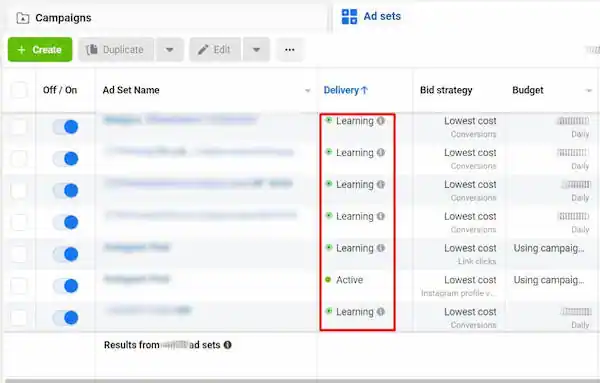
As a result, performance during the learning phase tends to be variable and not yet stabilized. This learning phase is triggered when you create a new ad set or make significant modifications to an existing ad or ad set.
Exiting the Learning Phase
An ad set exits the learning phase once its performance stabilizes. Typically, stability is achieved after an ad set accumulates approximately fifty optimization events within a seven-day period.
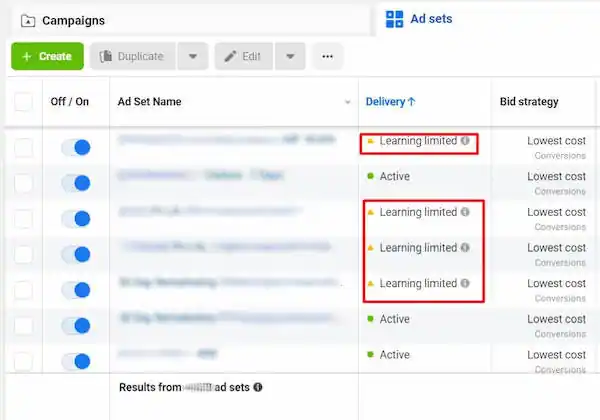
If your ad set does not receive enough optimization events to exit the learning phase, or if the delivery system predicts insufficient future optimization events, the Delivery column will indicate “Learning Limited“.
Understanding the importance of the learning phase
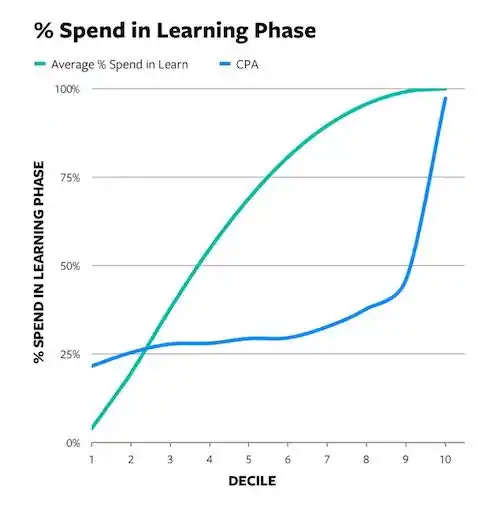
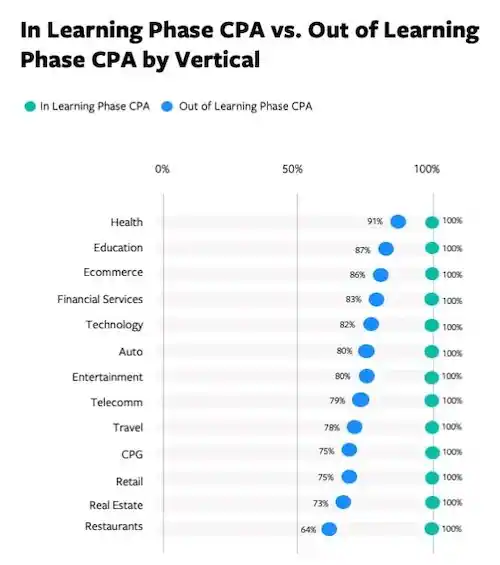
During the learning phase, the delivery of ads is not yet optimized, which means that ad sets in this phase exhibit less stability and often have higher CPA (Cost Per Acquisition). The graphs provided below demonstrate the impact of the learning phase on CPA.*
When a smaller portion of the budget is allocated to the learning phase, a higher proportion of the budget is spent on achieving stable performance, resulting in lower CPA.
Advertisers who allocate approximately 20% of their budget to the learning phase (second decile) experience 17% more conversions and a 15% lower CPA compared to advertisers who allocate around 80% of their budget to the learning phase (sixth decile).*
*Note: The graphs and percentages are provided for illustrative purposes.
Hence, advertisers should strive to avoid actions that hinder the exit of ad sets from the learning phase. If your spending exceeds 20% during this phase or if your ad sets are labeled as “Learning limited,” I recommend reviewing the following recommendations for optimal results.
*Please note that the data provided is based on an average performance as of June 18, 2019. Individual ad sets may yield varying outcomes.
Optimizing Your Ad Spend
Minimize Frequent Edits
Frequent manual optimizations (edits) often hinder the exit of ad sets from the learning phase. Certain modifications to campaigns, ad sets, and ads can reset the learning phase. The following edits will cause an ad set to re-enter the learning phase:
Campaign:
- Adjusting budget (significant changes)
- Modifying bid amount (significant changes)
- Changing bid strategy
Ads:
- Any form of modification
Ad Sets:
- Altering targeting parameters
- Adjusting ad placements
- Changing optimization events
- Adding new creatives
- Modifying bid strategy
- Adjusting bid amount (significant changes)
- Changing budget (significant changes)
- Pausing for a duration exceeding seven days
Tip #1: Minimize Edits during the Learning Phase
To minimize spending during the learning phase, refrain from making edits to an ad set or ad until it has successfully exited the learning phase. This approach ensures that your optimization decisions are based on more reliable results, providing a better indication of future performance.
If you have multiple edits to implement, it is recommended to batch them together and make them all at once. This way, the learning phase is only reset once, allowing for more consistent and efficient optimization.
Tip #2: Limit the number of Ad Sets
Having a large number of ad sets is another factor that can hinder ad sets from exiting the learning phase. When advertisers run too many ad sets simultaneously, each ad set receives fewer opportunities for delivery.
Consequently, fewer ad sets are able to exit the learning phase, and a significant portion of the budget is spent before the delivery system can fully optimize performance.
To address this issue, I recommend practicing account simplification by consolidating your ad sets. When advertisers consolidate their ad sets, they also consolidate the delivery learnings for their ads. This consolidation allows for a more focused and effective learning process, leading to improved overall performance and cost efficiency.
Tip #3: Accelerate your learning phase with effective strategies
Here are some alternatives to mitigate the impact of high ad set volume and expedite your learning phase:
-
Geographical Targeting:
- Instead of creating numerous ad sets for multiple small geographical areas, consider combining similar ad sets into fewer, larger ad sets. Alternatively, use the Store Traffic objective if applicable to your campaign goals.
-
Placement Optimization:
- If you have multiple ad sets dedicated to different placements, opt for automatic placements and leverage asset customization. This approach enables the delivery system to optimize ad placement based on performance data.
-
Multilingual Ad Sets:
- Rather than creating separate ads or ad sets for different languages, consider setting multiple languages within a single ad set. This allows for dynamic ad display in the appropriate language based on the audience reached, enhancing relevancy and efficiency.
By implementing these strategies, you can streamline your ad campaign structure, optimize performance, and reduce the time spent in the learning phase.
Tip #4: Embrace the Learning Phase for continuous improvement
While it’s crucial to avoid actions that hinder ad sets from exiting the learning phase, it’s equally important not to entirely avoid the learning phase itself. The learning phase plays a vital role in enhancing your performance over time by allowing you to test new creative and marketing strategies.
It enables the delivery system to optimize the performance of your new ads.
Here’s why embracing the learning phase is beneficial:
- Testing New Strategies:
- The learning phase provides an opportunity to experiment with different creative approaches, marketing strategies, and audience targeting. By testing new ideas during this phase, you can gather valuable insights and refine your ad campaigns for better results.
- Optimization and Performance Improvement:
- The learning phase enables the delivery system to learn and optimize the delivery of your new ads. It helps identify the most effective audiences, placements, and ad formats, leading to improved performance over time.
- Continuous Growth:
- Embracing the learning phase allows you to continuously evolve and adapt your advertising strategies. It fosters a culture of innovation and ensures that you stay ahead of the competition by discovering new approaches that resonate with your target audience.
Remember, while it’s essential to minimize actions that impede ad sets from exiting the learning phase, fully leveraging this phase is crucial for ongoing improvement and long-term success.
Embrace the learning phase as a valuable opportunity to refine your strategies and optimize your ad campaigns for optimal results.
Avoid constrained setups
It’s important to be aware that certain campaign and ad set settings can limit the conversion volume an ad set receives, preventing it from exiting the learning phase. To assess the performance of an ad set in the learning phase, use the Delivery view and follow these guidelines:
-
Monitor Conversion Volume:
- Keep an eye on the conversion volume your ad set is generating. If the volume is consistently low, it may hinder the ad set’s ability to exit the learning phase.
-
Evaluate Campaign and Ad Set Settings:
- Review your campaign and ad set settings to ensure they are not unnecessarily restricting the delivery or conversion potential. Adjust any settings that may be limiting the conversion volume.
-
Use Delivery View:
- Make use of the Delivery view to assess the performance of your ad set during the learning phase. This will provide insights into the delivery status and help identify any issues affecting the conversion volume.
By actively monitoring and diagnosing the learning phase performance of your ad set, you can identify any low conversion volume issues or constrained setups. Making the necessary adjustments will help optimize your ad campaign and increase the chances of a successful exit from the learning phase.
Managing low budgets
For ad sets to successfully exit the learning phase, it’s essential to allocate sufficient budget to facilitate around fifty optimization events within a seven-day timeframe.
Consider the following points regarding budget allocation:
-
Adequate Budget Provision:
- Ensure that your ad set has a reasonable budget that allows for the accumulation of approximately fifty optimization events within seven days. Insufficient budget allocation may hinder the delivery system’s ability to optimize effectively.
-
Avoiding Extremely Low or Inflated Budgets:
- Setting an extremely small budget restricts the delivery system’s ability to gather enough data for optimization. Conversely, an excessively inflated budget can lead to inaccurate targeting and suboptimal results.
-
Accurate Optimization Indicators:
- Providing an appropriate budget allows the delivery system to receive accurate indicators about the ideal target audience and optimize accordingly. This enables the delivery system to deliver ads to the most relevant individuals for optimal performance.
By ensuring that your ad sets have a suitable budget, you enable the delivery system to collect enough data for effective optimization. This ultimately improves the performance and success of your ad campaigns.
Managing low bids or cost caps
If you are using bid cap, target cost, cost cap, or value optimization with a minimum ROAS that limits your ad sets from obtaining approximately 50 conversions within a 7-day duration, it may prevent the ad sets from successfully exiting the learning phase.
Consider the following guidelines:
-
Evaluate Bid or Cost Cap Settings:
- Review your bid cap, target cost, cost cap, or value optimization with minimum ROAS settings. Ensure they are not overly restrictive, preventing your ad sets from reaching the desired number of conversions within the designated timeframe.
-
Adjusting Optimization Parameters:
- If your bid or cost cap settings are impeding the ad sets from accumulating enough conversions, consider adjusting these parameters to allow for a more reasonable number of conversions within the learning phase.
-
Finding the Right Balance:
- Strike a balance between achieving the desired performance goals and providing sufficient room for your ad sets to generate the necessary number of conversions. Experiment with different bid or cost cap settings to find the optimal balance for your specific campaign objectives.
By optimizing your bid or cost cap settings, you increase the likelihood of your ad sets successfully completing the learning phase and achieving the desired results.
Continuously monitor and fine-tune these parameters to strike the right balance between performance goals and the learning phase requirements.
Managing small audience sizes
It is important to note that larger audience sizes have a higher probability of generating sufficient conversions for an ad set to exit the learning phase successfully.
Consider the following recommendations:
-
Expand Your Target Audience:
- If you are working with a small audience size, consider expanding your target audience parameters. Broaden your targeting criteria to include a larger pool of potential customers. This increases the chances of generating a higher volume of conversions within the learning phase.
-
Revisit Audience Segmentation:
- Review how you have segmented your audience. Assess if your segmentation strategy can be adjusted to reach a broader audience while still maintaining relevance. Experiment with different segmentation approaches to find the right balance between audience size and targeting precision.
-
Explore Lookalike Audiences:
- Consider leveraging lookalike audiences to expand your reach. Lookalike audiences are created based on the characteristics and behaviors of your existing high-converting customers. By targeting these audiences, you can tap into a larger pool of potential customers who share similar traits to your existing customer base.
By focusing on expanding your target audience and refining your audience segmentation strategies, you can increase the likelihood of generating sufficient conversions for your ad sets to successfully exit the learning phase.
Continually monitor and adjust your targeting parameters to optimize performance based on audience size and conversion goals.
Managing infrequent conversion events
If your conversion event occurs less than 50 times within a week, it is advisable to optimize for a more frequently occurring event. For instance, if you observe fewer than 50 purchase events in a week, consider optimizing for add-to-cart events instead.
Here are some considerations:
-
Optimize for More Frequent Events:
- By optimizing for a conversion event that happens more frequently, you increase the likelihood of accumulating a sufficient number of conversions within the learning phase. This provides more data for the delivery system to optimize your ad sets effectively.
-
Select a Relevant Alternative Event:
- Choose a conversion event that is closely related to your main objective and occurs more frequently than your current event. For example, if purchase events are infrequent, focusing on add-to-cart events can still indicate user interest and provide more optimization opportunities.
-
Conversion Window Duration:
- Keep in mind that ad sets with longer conversion windows may require additional time to exit the learning phase. Be patient and allow sufficient time for the ad sets with longer conversion windows to gather enough data for optimization.
By optimizing for a more frequent conversion event and aligning it with your campaign objectives, you increase the chances of successfully exiting the learning phase.
Remember that ad sets with longer conversion windows may need more time to accumulate enough data, so ensure you provide ample time for optimization to take effect.