What is Quality Score?
The Quality Score is designed to provide insight into the quality of your ads relative to other advertisers. It is measured on a scale of 1-10 and assessed at the keyword level.
A higher Quality Score indicates that your ad and landing page are more pertinent and beneficial to someone searching for your keyword, in contrast to other advertisers.
By using the Quality Score diagnostic tool, you can recognize areas where it might be advantageous to enhance your ads, landing pages, or keyword selection.
It’s important to note that Quality Score is not a key performance indicator and should not be optimized or aggregated with your other data.
Additionally, Quality Score is not a factor in the ad auction. Rather, it’s a diagnostic tool to assess how ads that appear for particular keywords influence the user experience.
How is it calculated?
The Quality Score is determined by the combined performance of three key components:
- Expected clickthrough rate (CTR)
- Ad relevance
- Landing page experience.
The Expected CTR evaluates the likelihood of your ad being clicked when displayed to the user. The Ad relevance assesses how closely your ad matches the user’s search intent. The Landing page experience measures the relevance and usefulness of your landing page to people who click on your ad.
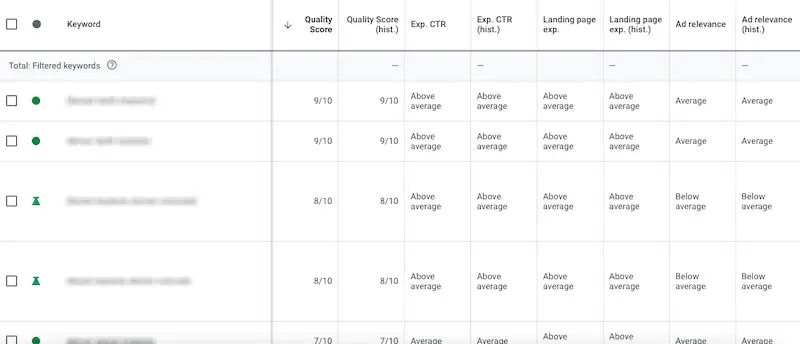
Each component is analyzed and given a status of “Above average,” “Average,” or “Below average,” based on a comparison with other advertisers whose ads appeared for the same keyword within the past 90 days.
If any of these components have a status of “Average” or “Below average,” it may suggest an opportunity to enhance your ad quality.
Things to know
It’s important to note that Quality Score is based on the historical impressions of exact keyword searches, so altering the keyword match types won’t have any effect on Quality Score. If you see a “—” in the Quality Score column, it indicates that there aren’t enough searches exactly matching your keywords to determine the Quality Score.
Additionally, there are various factors that influence your ad quality that may not be reflected in the Quality Score. These factors include, but are not limited to, the device used in the search, the user’s location, time of day, and assets.
Furthermore, information obtained from Google’s different crawlers may be used to evaluate ad quality, which can impact the Quality Score.
How to see your Quality Score
To check your Quality Score in Google Ads:
- Click on the Campaigns icon in your Google Ads account.
- Select the Audiences, keywords, and content dropdown from the section menu.
- Choose “Search keywords“.
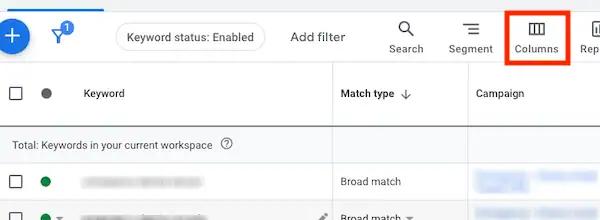
- Click the Columns icon in the upper right corner of the table.
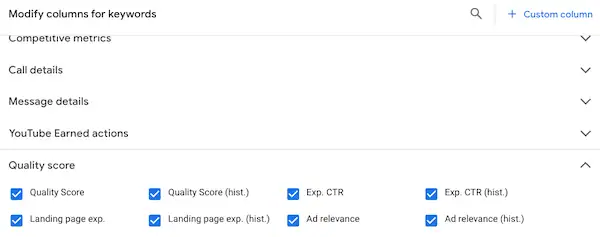
- Open the Quality Score section under “Modify columns for keywords“.
- To view your current Quality Score and its component statuses, add any of the following to your statistics table: Quality Score, Landing Page Exp., Exp. CTR, or Ad Relevance.
- To see past Quality Score stats for the reporting period you’re reviewing, select any of the following metrics: Quality Score (hist.), Landing Page Exper. (hist.), Ad Relevance (hist.), or Exp. CTR. (hist.).

Check columns to add them Quality Score columns - Segment your table by day to view the daily changes in scores.
- Click “Apply” to view your Quality Score data.
4 ways to use Quality Score to improve your performance
Quality Score is a helpful tool to identify opportunities for improving your ad quality, keywords, and landing pages. Instead of solely focusing on optimizing your score, think of it as a general indicator of areas to enhance.
Let’s learn 4 ways to leverage your Quality Score for improving your performance.
-
Review your Quality Score components To identify specific areas for improvement, analyze the three components of Quality Score:
- Expected clickthrough rate: The probability that your ad will be clicked when displayed.
- Ad relevance: How well your ad aligns with a user’s search intent.
- Landing page experience: How relevant and valuable your landing page is to users who click your ad.
Each component has a status of “Below average,” “Average,” or “Above average” to highlight the areas that require enhancement. Based on this analysis, you can update your ad copy, keyword selection, or landing page content to provide users with a better experience.
Remember that your long-term performance goals should guide your approach, and Quality Score is a diagnostic tool to help you achieve them. Prioritize user satisfaction by offering them relevant and useful content, and the performance should follow.
-
Improve your Clickthrough Rate (CTR)
- The expected clickthrough rate (Exp. CTR) is an indication of how likely people are to click on your ad. If your Exp. CTR is “Below average” or “Average,” try the following strategies:
- Use compelling ad text that resonates with your target audience.
- Ensure that your ad details align with the intent of your keywords.
- Highlight unique benefits of your product or service, such as exclusive offers or a limited-time promotion.
- Experiment with different calls to action that match your landing page content.
- Use strong calls to action such as “Buy, Sell, Order, Browse, Find, Sign up, Try, Get a Quote.”
- Be specific in your ad text to attract the right audience.
For example, let’s say you offer a fitness app. Adding a phrase to your ad like “personalized workout plans” may attract people looking for customized fitness routines. On the other hand, phrases like “professional trainers” or “real-time progress tracking” may engage people looking for guidance and motivation.The customized workout message may get you more clicks, but may not result in as many long-term subscribers who are willing to pay for your premium features.
-
Improve the relevance of your ads to keywords
Ad relevance measures the extent to which your ads match the intent behind a user’s search.
To improve Ad relevance when it has a status of “Below average” or “Average,” consider these best practices:
- Use language in your ad text that closely matches the search terms users are using.
- Group your keywords into specific themes to improve relevance. These themes can be based on your products, services, or other categories.
- Split up ad groups with many different keywords that can’t be easily addressed by the same ad into multiple ad groups that better match the user’s searches.
Remember, transferring an ad group with the same ads and keywords to another campaign or account will not affect your ad quality.
-
Consider editing your landing page
To succeed in online marketing, providing an excellent experience on your website is crucial. This goes beyond just bringing visitors to your site.
If your Landing page exp. has a status of “Below average” or “Average,” try these best practices:
- Ensure that your landing page aligns with what people are searching for. If someone clicks on your ad for “flannel shirts,” the landing page they arrive at should showcase your flannel shirt inventory.
- Keep the messaging consistent from ad to landing page. Ensure that the page delivers on the ad’s promise or call to action. Even if you have no control over your website, you can still experiment to find the most useful existing pages.
- Use conversion rate as a measure of a good landing page experience. Although it does not impact your landing page status, it can be an effective way to measure and optimize.
- Optimize your website for mobile devices. Users value ease of navigation, especially on mobile websites. Use the Mobile-Friendly Test to evaluate how well your landing page works on mobile devices.
- Enhance the loading speed of your landing page. Faster loading speeds can be the difference between a user bouncing or making a purchase.
Keep in mind
To improve your Google Ads performance, don’t just rely on Quality Score. Consider other metrics like clickthrough rate, conversion rate, and site engagement. Use Quality Score as a filter to pinpoint areas for improvement. Identify high-performing keywords that can do even better with tweaks to your ads and landing pages. Analyze low Quality Scores to find trends in ad relevance, clickthrough rate, and landing page experience, and make long-term plans to improve.