Google Ads Ad Rank explained: how ads cycle through the results pages (2026)
 Daniel Timponi · November 15, 2026
Ad Rank is the set of values Google Ads uses to decide whether your ad can show at all and, if it can, where it appears compared with other advertisers’ ads. It is calculated fresh in every auction, from your bid, the quality of your ad and landing page, the Ad Rank thresholds, the competition, the context of the search and the expected impact of your assets. That’s why your ad can be first on one search, third on the next and missing on the one after.
Paying more per click than you think you should? Ad Rank is usually where the answer is. Get in touch for a Google Ads audit.
What Ad Rank is
Every time someone searches on Google and ads could show, Google runs an auction. In fact it runs a separate auction for each ad location on the page, and Ad Rank is calculated again in each one. Google describes it as being calculated twice in an auction:
- To decide eligibility. Your ad must meet the minimum Ad Rank (the threshold) for that location, or it can’t show there.
- To decide the order. Among the eligible ads, the one with the highest Ad Rank generally gets the highest position.
There is no fixed score you can look up in your account. Ad Rank exists only at auction time, for one search, and is gone a moment later. What you can see are the results of it: impressions, position metrics, impression share and what you pay per click.
The six factors in Ad Rank
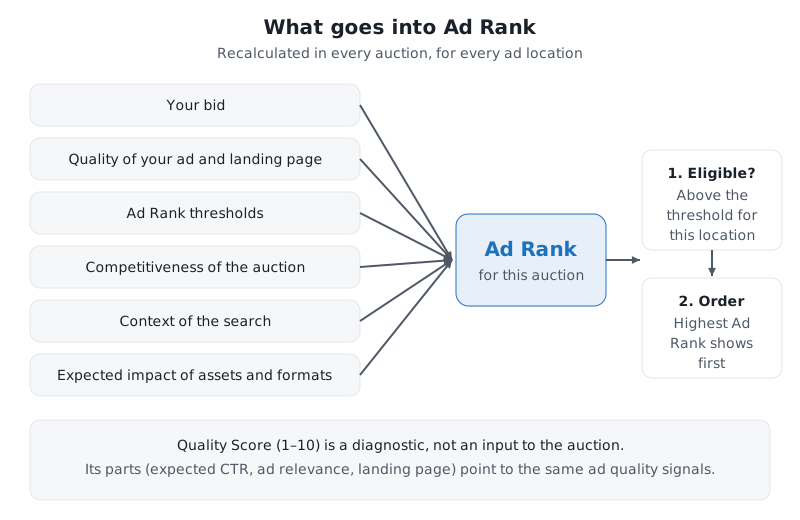
Google lists these factors:
- Your bid. The most you are willing to pay for a click. With Smart Bidding, Google sets this bid for you in each auction from your target and budget. What you actually pay is often less.
- The quality of your ads and landing page. How relevant and useful your ad and the page behind it are to the person searching. Google measures this at auction time from signals such as expected clickthrough rate, ad relevance and landing page experience.
- The Ad Rank thresholds. The minimum an ad has to reach to show in a location (more below).
- The competitiveness of the auction. If competitors are close to you in Ad Rank, the gap matters. Two ads with similar Ad Rank compete harder for the position, which can push up prices.
- The context of the search. The words searched, the person’s location, device and time of search, the other ads and results on the page, and other signals about the user.
- The expected impact of your assets and other ad formats. Google estimates how much your sitelinks, callouts, images, business name and logo and other assets (formerly called “ad extensions”) will help the ad, based on their relevance, clickthrough rate and prominence. An ad with good assets can beat a higher bid.
The practical lesson from Google’s own explanation: a higher bid doesn’t guarantee a higher position. A relevant ad with a good landing page can win a better position at a lower price.
Where does Quality Score fit?
Many guides still say “Ad Rank = bid × Quality Score”. That formula is out of date. Google is explicit that Quality Score is a diagnostic tool and not an input in the ad auction. It’s a 1–10 summary at keyword level, built from three parts rated Above average, Average or Below average: expected CTR, ad relevance and landing page experience. Those three point at the same kind of ad quality that the auction does measure in real time, so improving them usually improves your Ad Rank, but the auction doesn’t read the number itself. I go deeper in 4 ways to use Quality Score to improve your Google Ads performance.
Ad Rank thresholds
Thresholds are the minimum Ad Rank an ad needs to compete. Google sets them dynamically, at the time of each auction, and they depend on:
- Ad quality. Lower quality ads face higher thresholds.
- Ad position. The thresholds for the top of the page are higher than for positions lower down. An ad can be good enough to show at the bottom of the page but not among the top ads.
- User signals. Location and device: thresholds can differ by country and between mobile and desktop.
- The nature of the search. The topic and intent of the search terms.
Thresholds also explain a cost question I get often: “Why did I pay so much when there was no ad below me?” If no competitor meets its threshold, your ad may be the only one, and you pay the reserve price, which is the threshold (rounded up to the smallest billable unit). So a click can be expensive even with no competition, especially when ad quality is weak.
Why your ads “cycle” through positions
People new to Google Ads often search for their own keyword, see the ad in third place, search again and see it first, then not at all. Nothing is broken. Several things change between those searches:
- Every search is a new auction. The search context changes (device, location, time, the exact words), and so do the ads that enter.
- Competitors’ budgets and bids change through the day. When a competitor’s budget runs out in the afternoon, you move up; when their Smart Bidding decides a search is valuable, they bid more.
- Your own Smart Bidding changes your bid per search. Target CPA, Target ROAS and Maximize conversions all set a different bid for each auction depending on how likely that search is to convert.
- Your budget. A campaign limited by budget isn’t entered into every auction it is eligible for, so on some searches your ad simply isn’t there.
- Each ad location has its own auction. Since Google’s April 2025 update to its Unfair advantage policy, the rule against showing more than one ad for the same business applies within a single ad location. So the same advertiser can appear both among the top ads and lower on the page in the same results page.
- Searching for your own ads skews it. Repeatedly searching without clicking can make your ad stop showing to you. Use the Ad Preview and Diagnosis tool instead; it shows the ad without counting an impression.
If you need to see where your ads actually showed, here’s how to see the position of your ads in Google Ads.
Which campaign wins when several are eligible?
If you run Search and Performance Max (or several Search campaigns) on overlapping keywords, Google picks one of your ads per auction. A Search keyword that is identical to the search term is preferred. Otherwise, the campaign or ad with the highest Ad Rank is selected. That’s another reason keyword hygiene matters: duplicate keywords across campaigns make it harder to predict which ad and landing page a search gets.
Top and absolute top: the metrics that replaced average position
Google retired “Average position” in 2019. Instead, it reports where your impressions appeared:
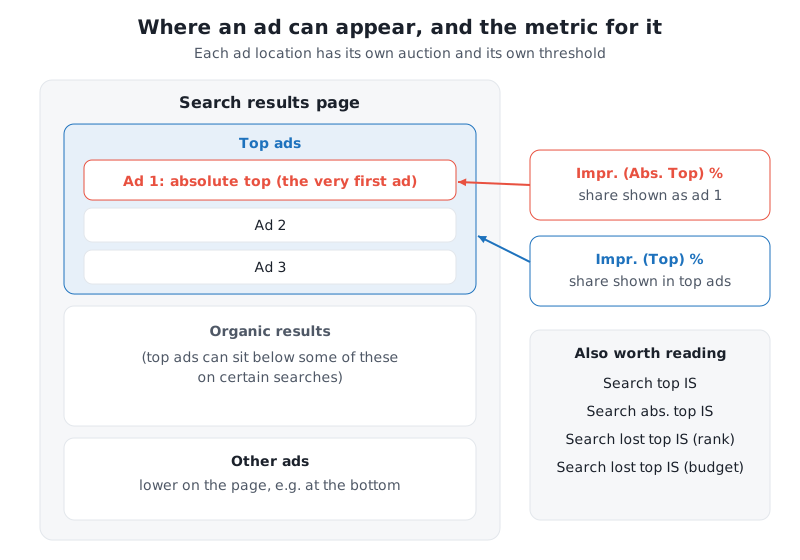
- Top ads usually appear above the organic results, but for certain searches they can appear below them. Google changed its definition in 2024 to reflect this.
- Absolute top is the very first ad among the top ads.
- Other is any ad shown elsewhere on the page, such as at the bottom.
| Metric | What it means |
|---|---|
| Impr. (Top) % | The percentage of your impressions shown among the top ads |
| Impr. (Abs. Top) % | The percentage of your impressions shown as the very first ad among the top ads |
| Search top IS | Impressions you got among the top ads, divided by the impressions you were eligible for there |
| Search abs. top IS | Impressions you got in the absolute top, divided by the impressions you were eligible for among the top ads |
| Search lost top IS (rank) | How often your ad didn’t show anywhere among the top ads because of poor Ad Rank |
| Search lost top IS (budget) | How often your ad didn’t show among the top ads because of low budget |
Two things to keep in mind. Absolute top counts the first ad on any results page, not only page one. And Search partners don’t distinguish between “top” and “other”, so read these metrics for Google Search on its own.
The lost (rank) and lost (budget) columns are the diagnosis. Lost to rank means the ad, the landing page or the bid isn’t strong enough; lost to budget means you are being left out of auctions because the money runs out. Compare yourself with competitors in Auction insights.
How to improve your Ad Rank
- Tighten relevance. Group keywords by meaning so each ad group’s responsive search ads can answer those searches directly, with the keyword’s idea in the headlines.
- Fix the landing page. It should match the ad’s promise, load fast on mobile, and make the next step obvious.
- Add assets that fit. Sitelinks, callouts, structured snippets, images, business name and logo, call and location assets where they apply. More relevant assets give Google more ways to show a stronger ad.
- Remove the searches you don’t want. Negative keywords stop weak, irrelevant auctions that drag down CTR.
- Give bidding enough room. A Target CPA far below your history or a budget too small for your keywords keeps you out of the top positions no matter how good the ad is.
- Don’t buy position for its own sake. The absolute top often costs much more per click; for many accounts, position two or three converts at a better cost. Let your conversion data decide, not your ego.
Common mistakes I see
- Bidding up to fix a quality problem. In the accounts I audit, a high cost per click with a high “lost (rank)” share usually comes from a weak landing page or generic ads, not from a low bid.
- Judging position by searching on your phone. Your own searches are a sample of one and can stop showing you the ad.
- Chasing a Quality Score of 10. It’s a diagnostic. A keyword with a 5 that converts profitably is better than a 9 that doesn’t.
- Reading top metrics across Search partners. Partners don’t report top versus other, which muddies the numbers.
FAQ
What is Ad Rank in Google Ads?
It’s the set of values Google uses in each auction to decide whether your ad is eligible to show and in what order it appears relative to other ads. It’s based on your bid, ad and landing page quality, thresholds, competition, search context and the expected impact of your assets.
Is Quality Score part of Ad Rank?
Not directly. Google says Quality Score is a diagnostic tool and not an input in the auction. Its components reflect the same ad quality signals the auction uses in real time, so improving them usually helps.
Why does my ad position keep changing?
Because every search is a separate auction, recalculated with that search’s context, the competitors present at that moment, Smart Bidding’s bid for that search, and your remaining budget.
Can I see my Ad Rank in Google Ads?
No. Ad Rank exists only during each auction. Use Impr. (Top) %, Impr. (Abs. Top) %, the top impression share metrics and Auction insights to judge your position.
Does a higher bid always get a higher position?
No. A higher bid helps, but an ad with better quality and assets can rank above a higher bidder and pay less per click.
Need help with your Ad Rank and costs?
If your ads rarely reach the top or every click feels too expensive, the fix is usually in relevance, landing pages and bidding, not a bigger bid. I audit and manage Google Ads accounts and can tell you where your Ad Rank is being lost. Book a call and let’s look at your account.