Demand Gen vs Performance Max vs Display: which campaign to run (2026)
 Daniel Timponi · November 14, 2026
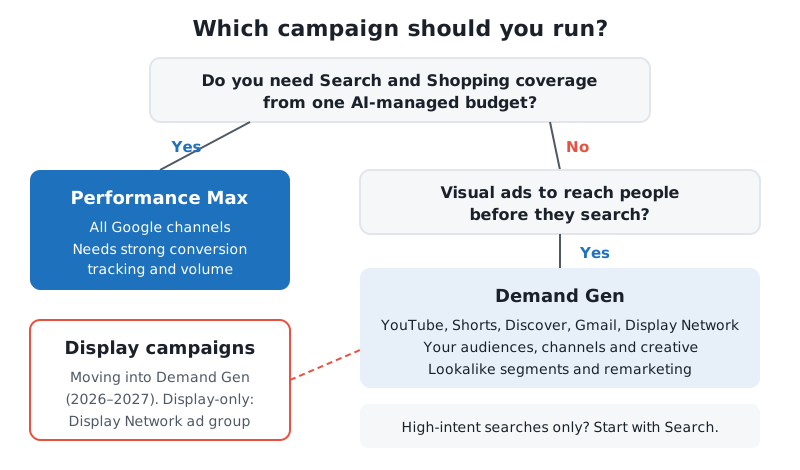
Run Performance Max when you want Google to find conversions across all of its inventory, Search included, from one budget. Run Demand Gen when you want to reach people before they search, on YouTube, Discover, Gmail and the Display Network, with control over audiences, channels and creative. Display campaigns are being moved into Demand Gen in 2026, so for new visual campaigns on the Display Network, Demand Gen is now where you build them.
Not sure which campaign types your account should be running? I audit and manage Google Ads accounts. Get in touch for a Google Ads audit.
The three campaign types in one sentence each
- Performance Max: goal-based, AI-led, runs on every Google channel (Search, Shopping, YouTube, Display, Discover, Gmail, Maps), with few manual controls. Full guide: Performance Max campaigns explained.
- Demand Gen: visual and video ads on YouTube (including Shorts), Discover, Gmail and the Google Display Network, with audiences you choose per ad group and channel controls. It replaced Discovery campaigns, which were upgraded to Demand Gen (my older post on Discovery campaigns covers where it started), and Video action campaigns are being upgraded to it too.
- Display: the classic Google Display Network campaign with responsive display ads, placements, topics and keywords. Google began moving Display campaigns into Demand Gen in June 2026.
Comparison table
| Performance Max | Demand Gen | Display (being migrated) | |
|---|---|---|---|
| Inventory | Search, Shopping, YouTube, Display Network, Discover, Gmail, Maps | YouTube (in-stream, in-feed, Shorts), Discover, Gmail, Display Network, Maps where available | Google Display Network (sites and apps) |
| Search ads | Yes | No | No |
| Channel controls | No per-channel opt-out; new priority and budget-share controls for Search partners and Display (rolling out from October 2026) | Choose channels per ad group (e.g. YouTube Shorts only, or Display Network only), plus channel prioritization | Display Network only |
| Creative | Asset groups: text, images, logos, videos; product feed | Image, video, carousel (2–10 cards) and product feed ads; you see and choose the formats | Responsive display ads, uploaded image ads, HTML5 |
| Targeting | Audience signals (hints only), search themes, feed, landing pages | Audience segments per ad group, including lookalike segments, your data, custom segments; optional optimized targeting | Audiences, placements, topics, keywords (contextual), optimized targeting |
| Bidding | Maximize conversions, Target CPA, Maximize conversion value, Target ROAS | Maximize clicks, target CPC, Maximize conversions / target CPA, Maximize conversion value / target ROAS | Manual CPC, viewable CPM and Smart Bidding |
| Reporting | Channel performance, search terms, asset and placement reports | Ad group, asset and channel-level reporting, lift studies | Placement, audience and ad reporting |
| Best for | Sales and leads across Google from one budget, when tracking is strong | Creating demand, YouTube and Shorts, remarketing, prospecting with lookalikes | Existing campaigns until migrated; Display-only buying now lives in Demand Gen |
What’s happening to Display campaigns
This is the biggest change of 2026. Google announced in May 2026 that Google Display Ads is moving into Demand Gen:
- June 2026: a migration tool began a phased rollout. It moves a live campaign with up to 42 days of performance history, which Google says cuts the learning time to about one or two days. Migrated campaigns are named “[original name] #2”, and the move can’t be reversed (the original is kept for reporting).
- Later: new Display campaigns can only be created inside Demand Gen, and remaining eligible campaigns are migrated automatically. Google hasn’t published exact dates for these steps; it expects the transition to finish in 2027.
- Display-only buying stays possible: a Demand Gen ad group can run on the Google Display Network alone, with the same network access as before.
What doesn’t carry over, per Google’s migration guide: manual CPC (use target CPC instead), viewable CPM bidding (use Maximize clicks), pay-for-conversions, bid adjustments and portfolio bidding. Uploaded HTML5 ads were not yet supported at migration and are planned for late 2026. Lead form assets, click-to-call assets, shared budgets and campaign-level content exclusions also block the migration tool until removed or moved to account level.
If you run Display today, my advice is not to wait for the automatic move: migrate one campaign with the tool, compare it for a few weeks, and fix anything that blocks the rest. My older guide to Google Display ads explains the formats and targeting that still apply inside Demand Gen.
How Demand Gen and Performance Max really differ
They overlap on YouTube, Discover, Gmail and Display, so the question is usually which one to use for that inventory.
Control. Demand Gen lets you choose the audience for each ad group, the channels, and the exact creative that runs. Performance Max takes your assets and signals and decides everything else. If you need to know that a specific video ran on Shorts to a specific audience, use Demand Gen.
Search. Only Performance Max shows on Search and Shopping. Demand Gen never does. That’s also PMax’s risk: much of its reported performance may come from Search and brand searches that would have converted anyway, which is why brand exclusions matter.
Intent. Demand Gen reaches people while they scroll and watch, before they look for you. It’s measured on conversions, but it usually has a higher cost per conversion than Search, and it feeds Search later. Judge it with that in mind, with lift studies or with data-driven attribution, not only last-click CPA.
Lookalikes. Demand Gen has lookalike segments built from your customer lists or website visitors (similar audiences are gone from other campaign types). PMax has no lookalikes, only signals.
When both campaigns are eligible for the same impression, the one with the higher Ad Rank serves, so running both is normal; just give each a different job.
Decision guide
- Do you sell products online with a Merchant Center feed and reliable purchase tracking? Performance Max is usually your main campaign, alongside Search for brand and core terms, and possibly Standard Shopping (see Google Shopping ads explained).
- Do you generate leads, and can your tracking tell good leads from bad? Start with Search. Add Performance Max only once you import qualified leads or sales as conversions.
- Do you want to grow demand, launch a product, or use YouTube and Shorts? Demand Gen.
- Do you want remarketing to past visitors with images and video? Demand Gen, with your own data segments.
- Do you buy Display placements today? Plan the migration to Demand Gen with a Display Network-only ad group.
- Small budget (a few hundred dollars a month)? Search first. Both PMax and Demand Gen need conversion volume to learn; Google recommends a Demand Gen budget of at least 10 times your target CPA when you use one.
Examples by business type
| Business | What I’d usually run |
|---|---|
| Ecommerce store | Search (brand and core), Performance Max with a clean feed, Demand Gen for product launches, seasonal pushes and remarketing with product feed ads |
| Local service business (dentist, plumber, lawyer) | Search for high-intent services; Performance Max with a call or store goal only with call tracking in place; Demand Gen video in the local area if the budget allows |
| B2B or high-ticket lead generation | Search, with offline conversions imported from the CRM; Demand Gen with lookalikes and customer lists for prospecting; PMax only when the CRM data flows back |
| App or content publisher | Demand Gen for YouTube and Discover reach; PMax only for sales or subscription goals |
| Brand already running Display | Migrate to Demand Gen, then test YouTube and Shorts on top of the Display Network |
Bidding: what to choose in each
- Performance Max: Maximize conversions or Maximize conversion value, or their target versions, Target CPA and Target ROAS (labelled “with a target” until June 2026). No clicks-based bidding. More in Target CPA bidding explained.
- Demand Gen: Maximize clicks or target CPC for early traffic or awareness, then Maximize conversions / target CPA once conversions flow. Google suggests counting lighter conversions (add to cart, key page visits) when a new campaign has too few sales to learn from, as secondary or temporary goals.
- Display: existing campaigns keep their strategies until migrated. Manual CPC and viewable CPM don’t exist in Demand Gen.
For the pros and cons of each Smart Bidding strategy, see Google Ads automated bidding strategies explained.
Common mistakes I see
- Running PMax and Demand Gen without separating their jobs. If both chase the same remarketing audience with the same creative, you pay twice for the same people.
- Judging Demand Gen on last-click CPA alone. It creates demand that converts later through Search. Compare against a holdout or a lift study before cutting it.
- Letting PMax take credit for your brand. Without a brand exclusion, PMax looks better than it is and Demand Gen looks worse.
- Image-only Demand Gen. Google’s own guidance is that video and image together usually perform better, and Shorts needs vertical video.
- Leaving Display campaigns to be migrated automatically with lead form assets, shared budgets or bid adjustments that won’t survive the move.
- Weak conversion tracking under all of it. Every one of these campaign types bids on your conversion data. Spam leads or duplicated conversions mislead all three.
FAQ
Is Demand Gen the same as Discovery campaigns?
Demand Gen is the upgrade of Discovery campaigns. Discovery campaigns were upgraded to Demand Gen, which added YouTube in-stream and Shorts, video ads, lookalike segments and, from 2025, the Google Display Network.
Are Display campaigns going away?
Standalone Display campaigns are being migrated into Demand Gen. A migration tool started rolling out in June 2026, new Display campaigns will later only be created in Demand Gen, and the rest are migrated automatically, with the transition expected to complete in 2027. Display Network ads themselves remain.
Can Demand Gen show ads on Google Search?
No. Demand Gen runs on YouTube, Discover, Gmail, the Display Network and Maps where available. Only Search, Shopping and Performance Max campaigns serve on Google Search.
Should I run Performance Max and Demand Gen together?
Often, yes, with different jobs: PMax for conversions across Google, Demand Gen for prospecting and video. When both are eligible for an impression, the one with the higher Ad Rank serves.
Which is better for YouTube ads?
Demand Gen, because you control the audience, the channel (for example Shorts only) and the creative. PMax uses YouTube, but you can’t decide how much of the budget goes there.
Need help choosing your campaign mix?
I review Google Ads accounts every week and decide with clients which campaigns earn their budget and which only look good in the report. If you want a clear plan for Performance Max, Demand Gen and your Display migration, book a call and we’ll go through your account.